Today I came to know about deepsec from AIEngineerGuide.com. It is an open-source vulnerability scanner that Vercel Labs released. It uses AI agents to review code, runs in your own infrastructure, and is built for large, existing codebases, where it hunts for bugs that have been hiding for a long time.
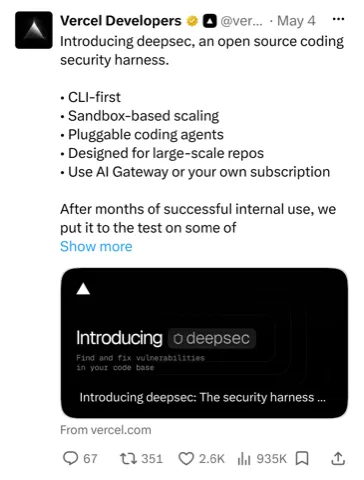
https://x.com/vercel_dev/status/2051381241283539255
What it is
deepsec is an AI-powered vulnerability scanner for existing codebases. You run it on demand against all the code in a repo, and it looks for the hard-to-find security issues that have been sitting in an app for years.
It runs in your own infrastructure. An AI agent reads your code through your own OpenAI or Anthropic key, or through Vercel AI Gateway. The only thing it adds to your repo is a .deepsec/ folder, where it keeps its state and findings.
Because an AI agent reads every file it reviews, each scan costs real money. So the core idea is to spend that money only where it matters.
How it works
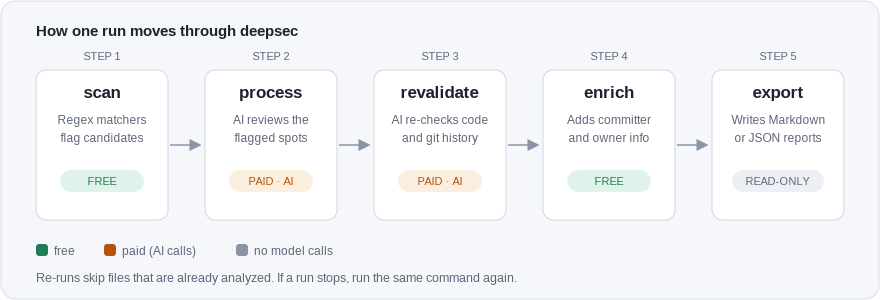
Three stages matter most:
- scan finds candidate spots with regex matchers. It is free and fast.
- process sends each candidate to an AI agent with the repo context and gets findings back.
- revalidate checks each finding against the code and git history. The verdict is
true-positive,false-positive,fixed, oruncertain.
Each file keeps one record, and nothing is overwritten. If a run stops partway, the same command picks up where it left off.
What it looks for
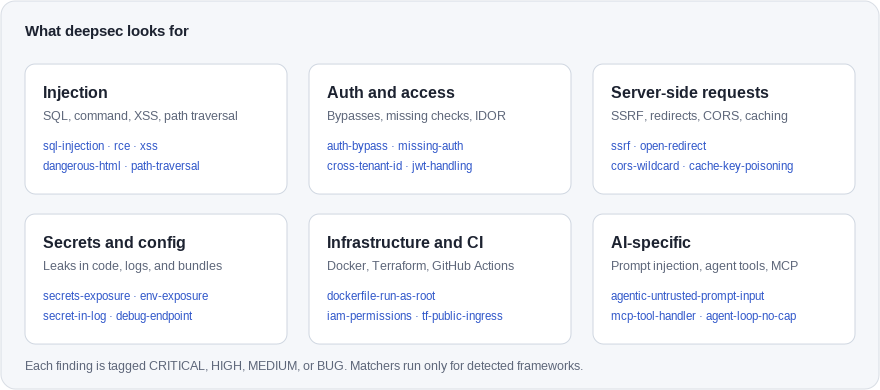
Matchers are tuned per framework, so coverage varies. The AI reviewer can also flag issues no matcher covers. It reads source only and never runs the code, so treat each finding as a lead to triage.
How it keeps the cost down
AI is the expensive part. deepsec limits how much code reaches it.
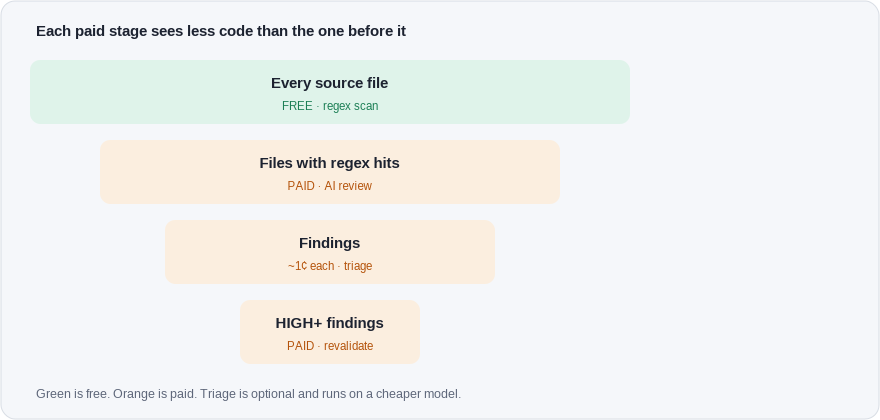
- Regex gate. Only files with a scanner hit go to the AI. Clean files cost nothing.
- No repeat work. Analyzed files are recorded, so re-runs skip them.
- PR mode.
process --diff origin/mainreviews only the files a pull request changes. CI cost follows the diff, not the whole repo. - Triage and revalidate. Triage sorts findings with a cheaper model, at about 1¢ each. Revalidate only HIGH+ findings, which is the paid check.
- Cheaper settings. Sonnet costs about a third of Opus, with a 10–20% higher false-positive rate.
--thinking-levellowers reasoning effort for quick runs. - Hard caps.
--max-cost-usdstops at a resumable boundary. Run with--limit 50first to calibrate.
For rough numbers, the docs estimate $130–300 for 500 files with Opus at default settings. Costs can swing 2–3× with file complexity.
Try it
npx deepsec initRun it from the root of the repo you want to scan. The docs are at deepsec.sh.